
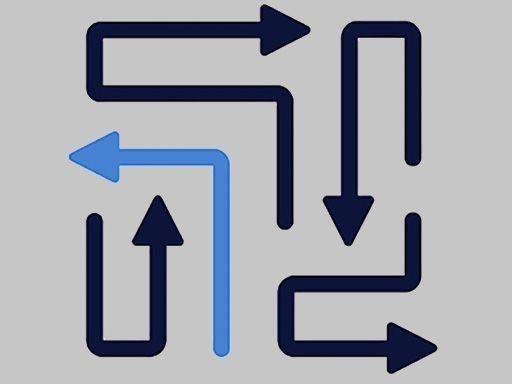
Tile Path Puzzle Challenge
Reviews
Tile Path Puzzle Challenge strips the puzzle down to one action: rotating tiles until their segments form a single route from start to exit. That simplicity is the point. Difficulty comes from larger grids and more intricate pathways, not from pressure, so the game rewards players who like to think a layout through before committing. The lack of timers and penalties makes it welcoming for younger players and anyone wanting a low-stress break. Its main limitation is narrow scope: if you want action or variety beyond tile rotation, this will not provide it.
About this game
The Rotation Mechanic
Each square on the grid holds a pathway segment, and the player's only action is to rotate those tiles until the segments line up. The goal is a single unbroken route running from a designated start point to an exit. Once the path is complete, a marker travels along it automatically, so the game confirms success by demonstrating the route rather than by scoring it. Because the marker only moves after the layout is finished, the real work happens before any movement: players must picture the final connected path in their head and rotate tiles toward that picture.
How Difficulty Grows
Early puzzles use small grids with few tiles, which lets a newcomer learn the rotation mechanic without much planning. Later puzzles expand the grid and make the pathways more intricate, so a single rotation can affect several possible routes at once. Every level uses a unique tile configuration, meaning the layout itself changes rather than the same board being repeated at higher speed. That structure builds spatial reasoning gradually instead of demanding it all at once, and it keeps each puzzle feeling like its own problem to solve.
Reading the Board at a Glance
The interface relies on bright, distinct colors for tiles and pathways, which makes connections easy to identify without close inspection. Start and end points receive subtle visual cues so players can orient themselves immediately. The clean presentation avoids clutter and keeps attention on the grid. Because nothing is hidden or timed, the game suits short breaks as well as longer focused sessions, and its friendly look makes it approachable for younger players who are still developing logic skills.
Feedback Without Pressure
Every rotation produces immediate visual feedback showing how the change affects neighboring tiles. That responsiveness lets players experiment freely and learn through trial and error without penalty. There are no timers and no scoring pressure, so a wrong rotation costs nothing but the time to rotate again. The result is a calm, reflective puzzle where careful analysis matters more than quick reactions, and where players can pause to think through a layout before committing to it.
Compatibility
FAQ
Comments
Sign in to leave a review
No comments yet.





Editorial Notes